
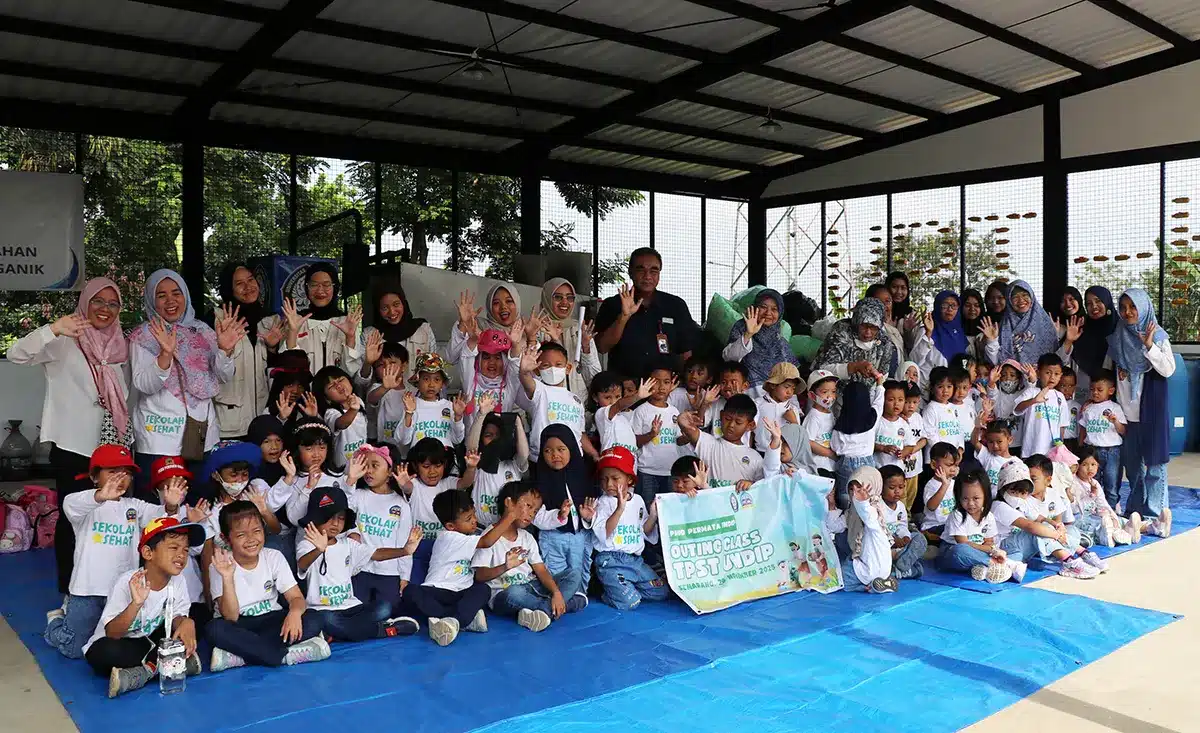
UNDIP, Semarang (November 26, 2025) – The Integrated Waste Management Facility (TPST) of the Occupational Safety, Health, and Environment Unit (UPT K3L) at Universitas Diponegoro once again welcomed an educational visit, following a similar activity held the previous day with 373 students from SD Islam Pangeran Diponegoro. On Tuesday, November 25, 2025, the TPST of UPT K3L UNDIP served as the venue for the PAUD Permata UNDIP Outing Class, themed “Clean Environment.”
The visit was attended by 57 children, consisting of Playgroup students (24 students), Kindergarten A (13 students), Kindergarten B (20 students), and 2 children from Daycare/TPA, accompanied by 8 teachers. Participants gained hands-on experience in waste management, waste types, and the importance of maintaining environmental cleanliness. Through an educational tour around the TPST area and an interactive briefing session, the children were introduced to waste-sorting processes, the management of organic, inorganic, and hazardous waste (B3), and the circular economy concept currently being developed by UNDIP.
During the tour, participants observed firsthand several waste-processing activities at UNDIP, including food waste processing using maggots as part of the circular economy, composting facilities, and pyrolysis technology for branch waste. The visit also included stops at Kedu Farm (chicken coop), the Maggot House, and the Organic Waste Processing Area. The children were introduced to how the equipment works, the function of each facility, and the basic concepts of sorting organic, inorganic, and B3 waste. In addition to staff from UPT K3L UNDIP, student volunteers also helped provide simple explanations to the children—such as the function of compost, how the pyrolysis process works, and the introduction of maggots, which are also used as chicken feed.
The Head of UPT K3L UNDIP, Dr. Bina Kurniawan, S.KM., M.Kes., expressed appreciation and warmly welcomed the children and accompanying teachers. “Please feel free to look around and enjoy everything here, and you may take photos as well. We have several waste management methods: organic waste, inorganic waste, and B3 waste. We hope you enjoy your time at the TPST and that it is beneficial. We are happy to welcome you all; it feels lively today,” he said.
Dr. Bina further introduced the facilities and several areas within the TPST that are part of UNDIP’s Zero Waste commitment, and encouraged the children to keep the environment clean by properly disposing of waste.
“We commit to UNDIP Zero Waste. So waste at UNDIP must not be thrown carelessly. Later, you should also not litter. Do not throw trash in the drains. If there is no trash bin nearby, keep it in your pocket first. And when you find a trash bin, throw it in the bin according to the color—red, yellow, or green. If you have trash, it must go in its proper place. Always throw trash in the designated bin,” he explained.
Meanwhile, the Principal of PAUD Permata UNDIP, Dra. Sri Sedyaningrum expressed her gratitude for the opportunity to provide direct learning experiences at TPST UNDIP and for accommodating the children despite their young age.
“Today, we want to see everything firsthand. Hopefully, the children will gain more knowledge and be able to apply what they learn at school and at home about waste management. We hope this becomes a meaningful and memorable learning experience for our students—even though they are still very young, including those who are only three years old,” she said.
Although they appeared tired, the children showed great enthusiasm. They actively answered questions about waste-bin colors, types of organic, inorganic, and B3 waste, and confidently responded during the picture-guessing game. Some even shared their experiences seeing maggots, chickens, and the composting process.
Kaina, a Kindergarten B student, said she enjoyed touring the TPST UNDIP. Kaina said, “It was fun, I’m happy. I learned about waste, organic, inorganic, and B3. I saw chickens, but they smell, and the maggots look like worms.”
This educational visit was held as a direct learning opportunity for children to understand the importance of cleanliness, proper waste management, the introduction of different waste types and correct waste-bin use, and to cultivate environmental awareness from an early age.
TPST UNDIP itself is a science-based integrated waste management center supporting the “UNDIP Zero Waste” movement, aimed at creating a clean, healthy, environmentally friendly, and sustainable campus ecosystem. Various science-based facilities and innovations have been implemented at the TPST, including Kedu Farm, the Maggot House, organic waste processing into compost, pyrolysis of branch waste into liquid smoke, and Dipofuel, which converts plastic waste into fuel. Additionally, UNDIP implements a standardized B3 waste management system and provides a Reverse Vending Machine (RVM) for exchanging plastic waste for digital points.
Beyond serving internal campus needs, TPST UNDIP also serves as a reference for schools, institutions, and local governments in integrated environmental and waste management. UPT K3L UNDIP continues to support the vision of strengthening a sustainable campus and the implementation of the Sustainable Development Goals (SDGs), particularly Good Health and Well-Being (SDG 3), Quality Education (SDG 4), Affordable and Clean Energy (SDG 7), Sustainable Cities and Communities (SDG 11), and Climate Action (SDG 13). (Public Communication/UNDIP/Nabila)